


By Maria del Mar Marais, Head of Programme Management at Lepra
The 2025 World Health Organization (WHO) update gives a mixed picture at the midpoint of the Global Leprosy Strategy 2021–2030. Globally, reported new cases fell by 3.1%, from 172,717 in 2024 to 167,356 in 2025. But this headline figure does not tell the whole story. What else can the data tell us?
A fall in reported cases can reflect genuinely lower transmission and successful treatment, but it can also result from reduced active case-finding (actively looking for people who may have leprosy, rather than waiting for them to come to a health facility for diagnosis), weaker surveillance or reporting, or barriers to accessing diagnosis.
Equally, an increase in reported cases does not necessarily mean that transmission has increased. More active case-finding can lead to more people being identified and, consequently, more cases being reported, without a corresponding increase in transmission. The report provides one indication of strengthened case detection: 92 countries reported identifying 8,332 new cases through contact tracing. These efforts, despite contributing to higher numbers, suggest greater investment in early detection and transmission control. For country-level comparisons, therefore, reported new case numbers need to be considered alongside how and where cases are being detected.
WHO identifies new Grade 2 disability (G2D) as an indicator of delayed case detection. In 2025, 9,428 new G2D cases were reported, representing 5.6% of all new cases and a 3.3% increase from 2024 (Table 1). Despite G2D cases having stagnated since 2022, the longer-term trend remains positive, with G2D 27.8% lower than in 2016. The 2025 increase therefore appears to reflect a plateau within a broader long-term decline, while highlighting the continued need to invest in early detection.
The picture among children is particularly concerning. 8,344 new child cases were reported in 2025, representing 5% of all new cases. While the child case detection rate has fallen by 55.8% since 2016, from 9.5 to 4.2 per million, 284 children developed G2D in 2025 compared with 256 in 2024, an increase of around 11%, across 33 countries.
Children developing leprosy are already an indicator of recent transmission. When a child develops G2D, it suggests that diagnosis has been delayed long enough for visible impairment to occur. This points to gaps somewhere along the pathway from transmission and early detection through to treatment and disability prevention.
Table 1: New cases, new G2D, new child cases with G2D

Overall, new cases fell by 3.3% globally, but individual countries moved in very different directions. Among the 23 global priority countries, 12 reported fewer new cases in 2025, while 10 reported more; Sri Lanka reported the same number.
Table 2: New cases at country level (2024 vs 2025)
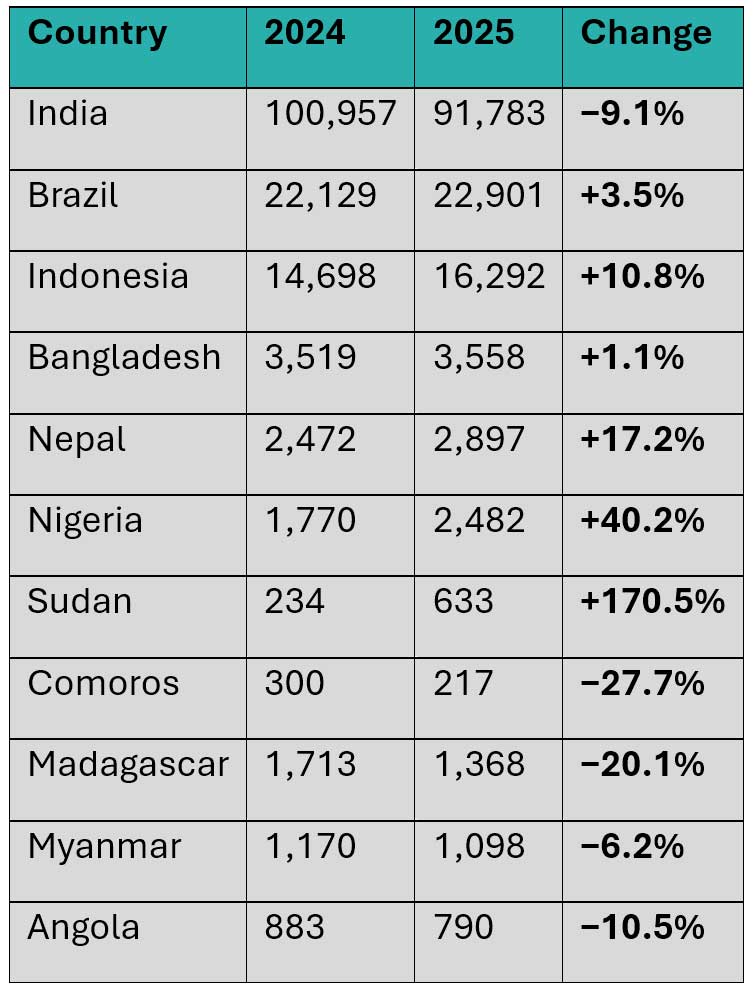
The report highlights Sudan, Nigeria and Egypt among countries with substantial increases in % of new cases, while Comoros recorded the largest % decrease among the priority countries.
India remained the largest contributor, despite reporting 9.1% fewer cases than in 2024. Brazil and Indonesia reported increases of 3.5% and 10.8%, respectively. Together, Brazil, India and Indonesia accounted for 78.3% of all global new cases, meaning that the global 3.1% decline figure is strongly influenced by trends in these high-burden countries.
Several other findings reinforce why new-case totals alone are insufficient:
Ultimately, the 2025 data suggests that the global decline in reported cases is important, but it needs to be read alongside how cases are detected, who is being diagnosed late, and whether people affected by leprosy can access the care and support they need.
At Lepra, in line with our global strategy, we understand that elimination is not simply about reducing the number of cases detected. We will continue to work to ensure that people can access diagnosis and treatment without financial or social barriers, receive disability prevention and psychosocial support, and participate meaningfully in the response.


